In contemporary drug development and high-efficacy cosmeceutical formulation, over 70% of emerging active pharmaceutical ingredients (APIs) and bioactive compounds belong to BCS (Biopharmaceutics Classification System) Class II and IV—exhibiting extreme hydrophobicity and poor aqueous solubility.
Traditional solubilization techniques, such as non-aqueous co-solvents, harsh surfactants, or micronization, often carry risks of systemic toxicity, tissue irritation, or physical recrystallization over time.
Hydroxypropyl Beta-Cyclodextrin (HP-β-CD) has emerged as the premier supramolecular excipient of choice worldwide. Engineered through the targeted etherification of native ββ-cyclodextrin, HP-β-CD provides extraordinary water solubility, superior biocompatibility, and versatile molecular encapsulation capabilities.
1. The Supramolecular Architecture: How HP-β-CD Works
Native β-cyclodextrin possesses a rigid crystalline lattice with a cyclic 7-dextrose ring, which limits its own aqueous solubility to approximately 1.85 g/100 mL at 25°C.
By introducing 2-hydroxypropyl ether groups onto the primary and secondary hydroxyl rims, the internal hydrogen-bonding network is disrupted, transforming the compound into an amorphous isomer mixture with an aqueous solubility exceeding 50 g/100 mL (>500 mg/mL).
* **Hydrophilic Outer Shell**: Composed of 2-hydroxypropyl functionalized glucose rims, which disrupt native crystallization and deliver exceptional aqueous solubility (>500 mg/mL) along with high clinical biocompatibility.
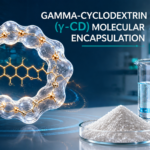
* **Hydrophobic Core Cavity (~0.60–0.65 nm)**: Provides a non-polar, lipophilic micro-environment tailored for encapsulating poorly water-soluble drug molecules, vitamins, and delicate cosmetic actives.
* **Controlled Inclusion Matrix**: Governed by reversible van der Waals and hydrophobic interactions, maintaining thermodynamic stability while enabling spontaneous release upon biological dilution.
The “Host-Guest” Inclusion Mechanism
- Cavity Entrapment: The central cavity (diameter ~6.0–6.5 Å) is lined with glycosidic oxygen bridges and carbon-hydrogen bonds, creating an energetically favorable lipophilic micro-environment.
- Water Molecule Displacement: High-energy water molecules inside the cavity are readily displaced by the non-polar moieties of guest molecules (e.g., steroids, polyphenols, hydrophobic aromatic rings).
- Dynamic Reversible Equilibrium: Non-covalent forces (van der Waals, hydrophobic interactions, and dipole-dipole attractions) stabilize the inclusion complex in solution, while releasing the free active compound upon systemic dilution or membrane contact.
2. Key Performance Advantages Across Applications
A. Pharmaceutical Formulations (Oral, Injectable, Ophthalmic & Nasal)
- Exponential Solubility Multiplication: Increases the apparent aqueous solubility of lipophilic drugs by 10 to over 10,000-fold.
- Elevated Bioavailability & Rapid Onset: Converts crystalline drugs into an amorphized, molecularly dispersed state, dramatically accelerating dissolution rate and gastrointestinal permeability.
- Hemolysis & Renal Safety: Significantly lower hemolytic potential and nephrotoxicity compared to native ββ-cyclodextrin and synthetic ionic surfactants, making it suitable for parenterals.
- Taste Masking & Mucosal Protection: Shields bitter, astringent, or irritating pharmacophores from direct contact with oral and gastric mucosal linings.
B. Premium Cosmetics & Dermal Delivery
- Stabilization of Delicate Actives: Protects light- and oxygen-sensitive actives—such as Retinol, Resveratrol, Astaxanthin, and Coenzyme Q10—against degradation and discoloration.
- Controlled & Sustained Release: Prevents the “burst release” irritation of high-concentration chemical exfoliants or anti-aging actives, sustaining continuous transdermal nourishment.
- Odor & Volatility Control: Entraps offensive sulfur or amine notes from raw ingredients while fixing volatile fragrance accords.
3. Product Comparison: Native ββ-CD vs. HP-β-CD
| Parameter / Feature | Native ββ-Cyclodextrin (ββ-CD) | Hydroxypropyl ββ-Cyclodextrin (HP-β-CD) | Advantage of HP-β-CD |
|---|---|---|---|
| Aqueous Solubility (25°C) | ~1.85 g / 100 mL | > 50 g / 100 mL | 25× higher solubility |
| Crystallinity | Highly crystalline | Amorphous mixture | Prevents precipitation |
| Parenteral Suitability | Restricted (nephrotoxic risk) | Approved for injectables | High clinical safety profile |
| Degree of Substitution (DS) | N/A (unmodified) | Customizable (4.0 – 9.0) | Tunable cavity dynamics |
| Viscosity & Clarity | Prone to turbidity | Ultra-clear, low viscosity | Seamless liquid dosing |
4. Formulation Guidelines: Maximizing Inclusion Efficiency
When formulating with HP-β-CD, R&D chemists should follow these proven laboratory protocols:
- Phase-Solubility Profiling (Higuchi-Connors Method): Perform concentration-gradient titration to establish ALAL-type or APAP-type solubility curves and calculate the 1:1 stability constant (K1:1K1:1).
- Synergistic Co-Solvents / Polymers: Incorporate micro-percentages of water-soluble polymers (e.g., PVP, HPMC) or organic acids (e.g., Citric Acid, Tartaric Acid) to form ternary complexes, reducing the required HP-β-CD molar ratio by 30–50%.
- Processing Options: Complexation can be achieved via aqueous stirring, high-shear homogenization, ultrasonic cavitation, spray drying, or lyophilization (freeze-drying) for solid dosage forms.
5. Why Partner with Zibo Weyes New Material Co., Ltd?
As a dedicated manufacturer and global supplier of cyclodextrin derivatives, Zibo Weyes New Material Co., Ltd delivers pharmaceutical-grade and cosmetic-grade HP-β-CD tailored to the rigorous demands of international formulators:
- High Purity & Low Residues: Controlled manufacturing processes with minimal propylene glycol and native cyclodextrin residues.
- Strict Quality Compliance: Certified under ISO standards, fully compliant with USP, EP, and ChP monograph specifications.
- Custom Degree of Substitution: Tailored DS ranges engineered for specific API molecular structures and dissolution kinetics.
- Global Supply Assurance: Scalable batch capacity, robust batch-to-batch consistency, and comprehensive DMF/COA technical dossiers.
Ready to Enhance Your Formulation’s Solubility Profile?
Whether you are formulating a breakthrough injectable, an advanced oral solid dosage, or an ultra-stable cosmetic serum, our technical formulation specialists are ready to support your R&D pipeline.
Contact Zibo Weyes Technical Support | Request a Sample & COA